Jylhä Prospect
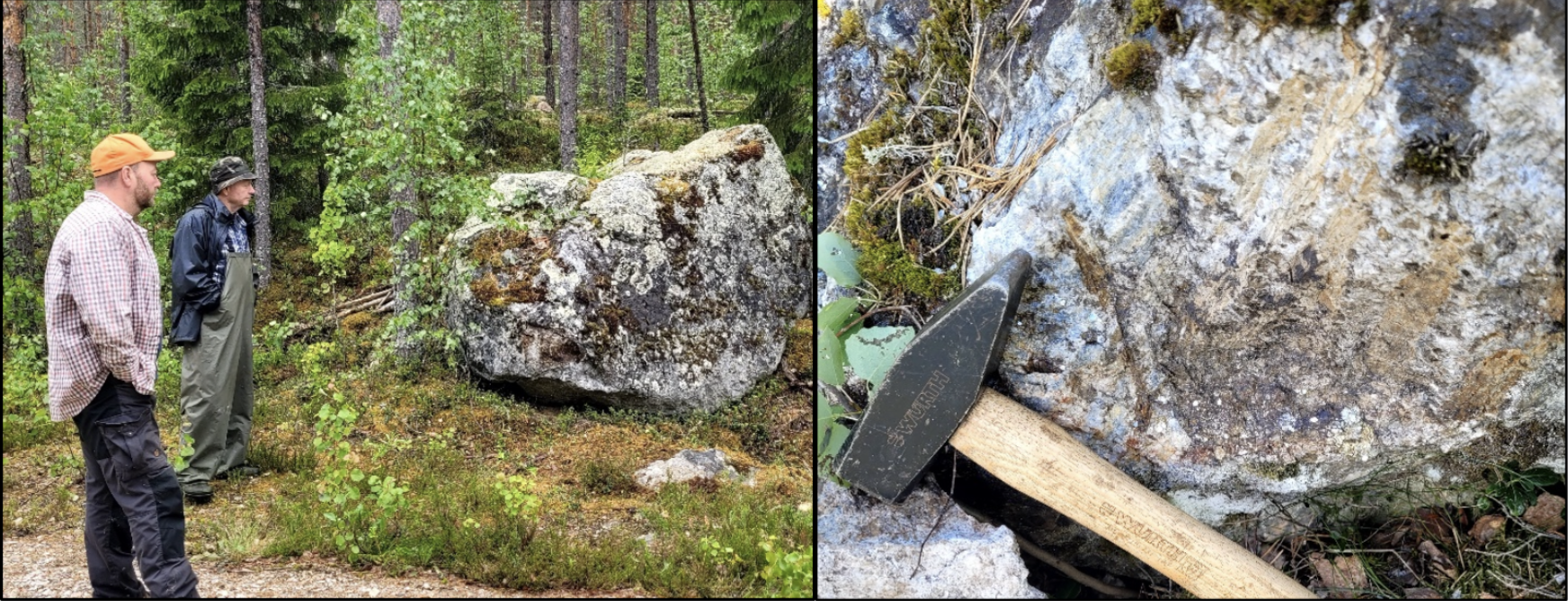
2.33% Li₂OJylhä discovery boulder; coarse spodumene crystals in the same boulder assayed 2.33% Li₂O.
Projects
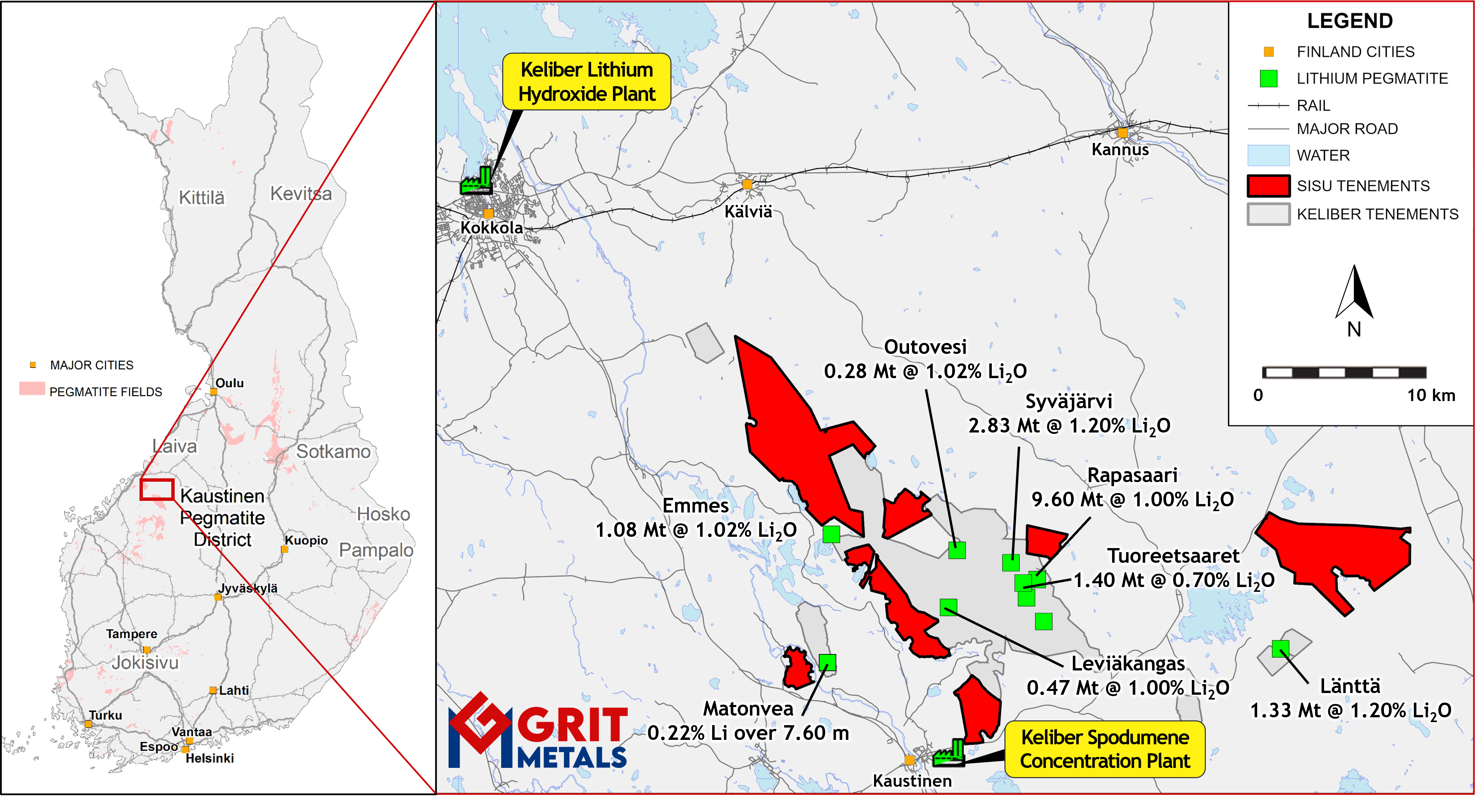
The Kaustinen tract in Central Ostrobothnia represents one of Europe's premier lithium districts. It hosts the substantial Sibanye-Stillwater (Keliber Oy) cluster of deposits, which contains approximately 18 million tonnes of high-grade spodumene pegmatite resources (>1% Li₂O).
(Source: Keliber Lithium Project, Finland Technical Report Summary Prepared for Sibanye-Stillwater Limited by SRK Consulting (South Africa) (Pty) Ltd. dated 2023-Dec-13 with an effective date of 2022-Dec-31. Note this is the source for all subsequent resource or reserve estimates on the remainder of this web page.)
Strategic Alignment with Europe’s Battery Supply Chain
Grit Metals Corp. has strategically positioned itself within this emerging industrial hub. Our Lithium Project covers 15,770 hectares adjacent to the Keliber deposit cluster. This location offers a distinct logistical advantage: our assets are situated less than 2 km from Keliber’s spodumene concentrator and approximately 25 km southeast of their Lithium Hydroxide Chemical Plant in Kokkola – both in the final stages of construction.
With Sibanye-Stillwater and the Finnish Minerals Group investing over €600 million to create Europe’s first integrated hard-rock lithium supply chain, Grit Metals' primary objective is to discover and delineate feedstock resources that can leverage this developing infrastructure.
Background
The lithium potential of the Kaustinen region was first identified in 1959 through the discovery of spodumene-bearing glacial boulders. This initial find catalyzed a decades-long exploration effort—primarily by the Geological Survey of Finland (GTK) and Keliber—that successfully defined multiple economic deposits.
Crucially, nearly every deposit in the Keliber cluster is a "blind discovery," identified by tracing glacial till and boulder trains back to their bedrock source. Grit Metals is applying this proven exploration methodology to its own vast land holdings to unlock similar value.
Geology
The Company’s projects are situated within the Kaustinen Lithium Pegmatite Province, a 500 km² prospective zone within the Palaeoproterozoic Pohjanmaa Schist Belt. This geological feature consists of a 350 km arc of metasedimentary rocks (schists and gneisses) intruded by late S-Type granitoids.
The northern sector of this belt is heavily intruded by Lithium-Cesium-Tantalum (LCT) type pegmatites of the albite-spodumene class. Historical drilling by GTK and Keliber has delineated five discrete LCT pegmatite deposits (Syväjärvi, Rapasaari, Länttä, Emmes, and Outovesi). These deposits are typically characterized by parallel dyke swarms ranging from 1 to 30 meters in width. The nearest known resources, the Emmes and Levikangas deposits, are located within 1.5 km of Grit Metals' license boundaries.
Mineralization
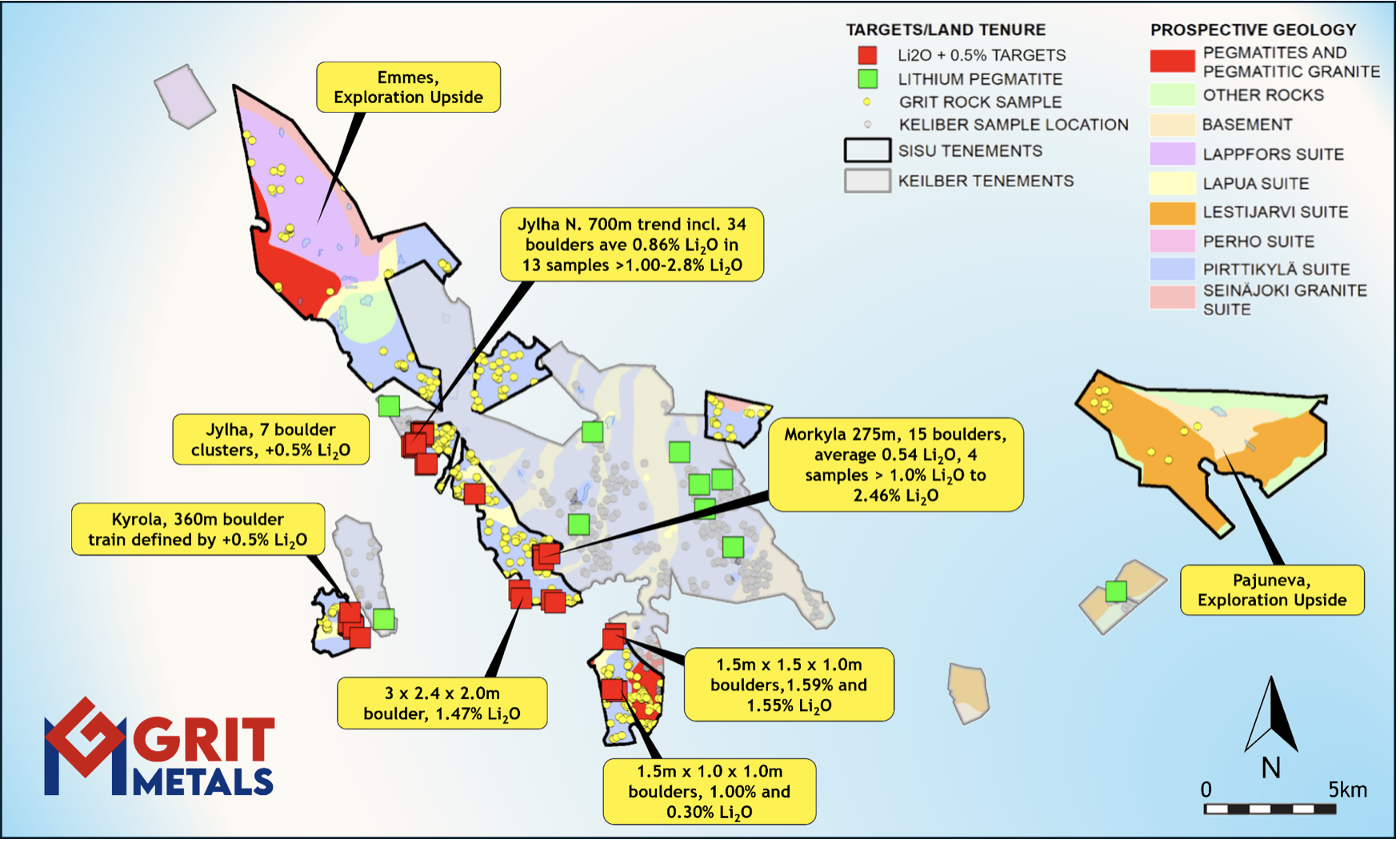
Since commencing exploration in July 2023, the Company has identified widespread mineralization, discovering several clusters and trends of spodumene-bearing pegmatite boulders. These findings strongly suggest the presence of local bedrock sources.
Jylhä discovery boulder; coarse spodumene crystals in the same boulder assayed 2.33% Li₂O.
Located 1.5 km west of the Keliber Levikangas deposit (0.47 Mt @ 1.00% Li₂O), this target features a 275m trend of 15 large boulders (up to 4m diameter). Sampling has returned grades up to 2.46% Li₂O with coarse visible spodumene.
Reconnaissance prospecting has identified three separate clusters of LCT pegmatite boulders over a 2 km by 4 km area. 32 sample points has confirmed lithium mineralization with values up to 1.59% Li₂O, five samples assaying >0.30% Li₂O.
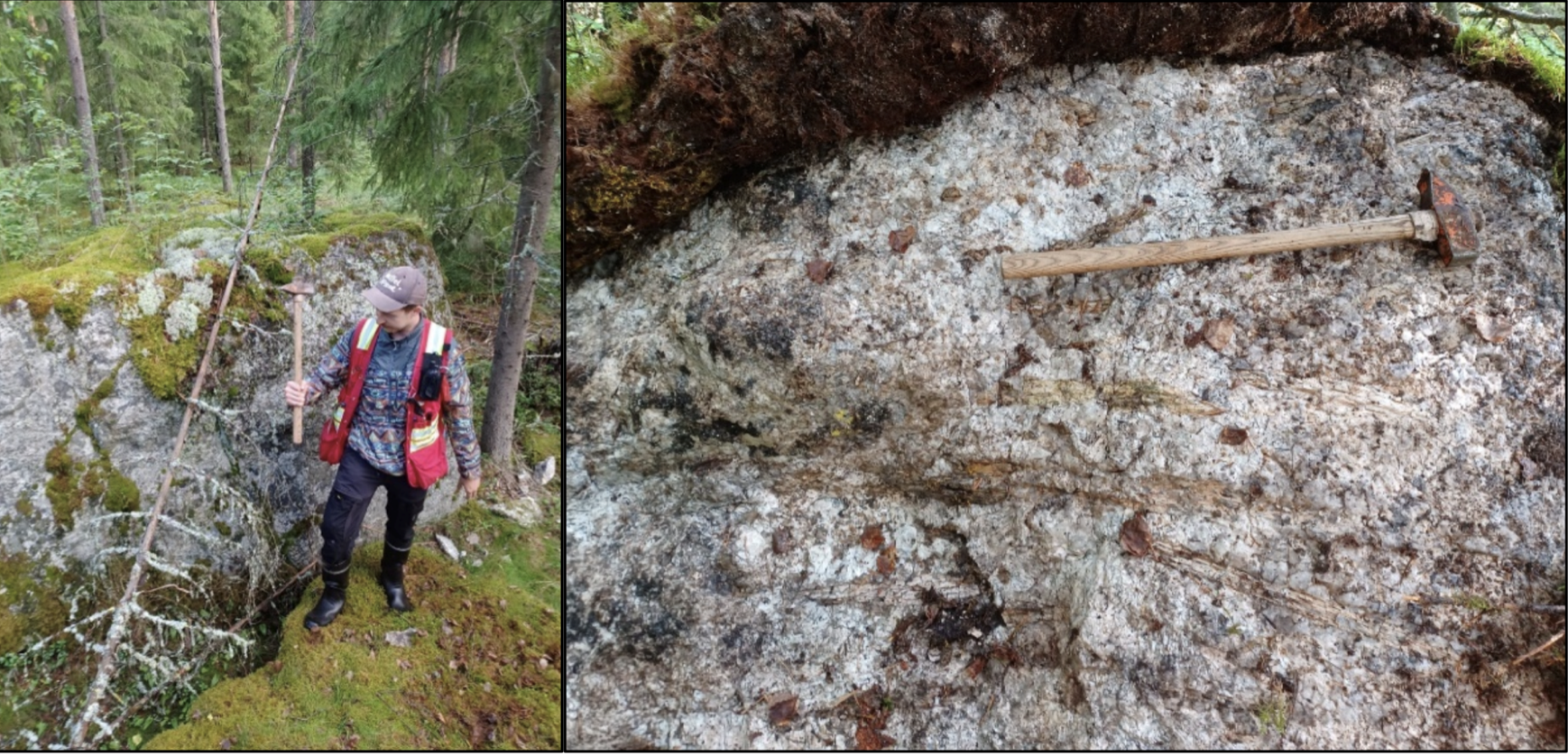
The Kyrola prospect represents the most significant discovery on the Nabba EL to date. An 850m x 110m boulder field was delineated, with 15 of 49 grab samples returning >0.50% Li₂O and peak values reaching 3.84% Li₂O.
Expansion: 2024 prospecting identified additional mineralized zones 2.3 km west and 6 km northwest of Kyrola, extending the prospective footprint. Additional test work to take place in 2025.
Mineralogy: The boulders consist of albite-spodumene-quartz-muscovite pegmatite, mineralogically consistent with the commercial deposits in the region. Based on glacial dispersion models (e.g. Ahtola et al, 2015), the bedrock source is interpreted to be located just 300–500 meters northwest of the boulder field.
Discussion
The Kaustinen-Seinajoki region is highly prospective for LCT pegmatite deposits, validated by the historical success of GTK and Keliber Oy. Grit Metals’ exploration results are highly encouraging; the identification of widespread, high-grade spodumene boulders in an area with thin glacial cover is the primary leading indicator for bedrock mineralization in this belt.
Our technical team notes that almost all significant discoveries in this province were made by tracing boulders to their source. The proximity of our high-grade boulder fields to their interpreted sources suggests excellent potential for discovery. The Company represents a compelling opportunity ato identify new lithium resources within one of Europe's most secure and logistically favorable mining jurisdictions.
Disclaimer: Grit Metals Corp. cautions investors that grab samples are selective by nature and are not necessarily indicative of average mineralization on the property. Furthermore, mineralization on adjacent properties (e.g., Keliber Oy) does not guarantee similar mineralization on the Company's mineral reservations.
Stay informed
Receive news releases and exploration updates from Grit Metals Corp. as they are issued.
503-905 West Pender StreetVancouver, BC, CanadaV6C 1L6604 722-9842info@grit-metals.com